Plate No. 22
Hens and Chicks
Sempervivum tectorum
"The roof-keeper of the old world"
Native to
Mountains of southern and central Europe

Identification
Is this your plant?
Compare these reference photographs to help identify a hens and chicks in your own collection.
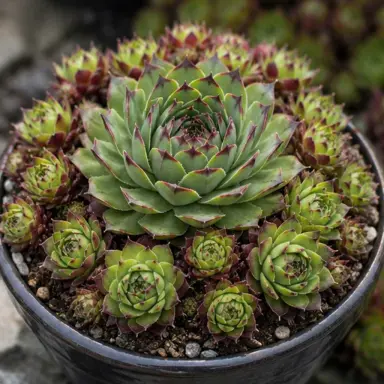 Whole plant
A Hens and Chicks shown in full — overall shape and habit.
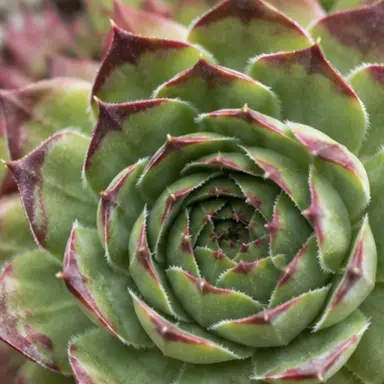 Leaf detail
Close-up of Hens and Chicks leaves — texture, color, and edges.
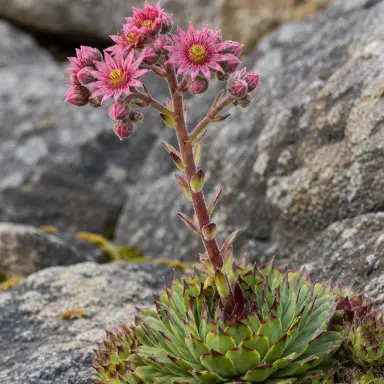 Flowers
Hens and Chicks in bloom — flower form and color.
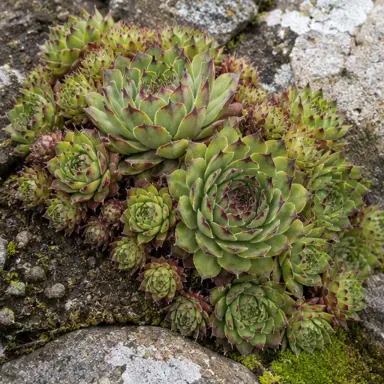 Growth form
Hens and Chicks growing habit — stems, base, and offsets.
History
A brief account
Hens and Chicks (Sempervivum tectorum) is one of Europe’s oldest cultivated succulents, admired for its perfectly symmetrical rosettes and extraordinary hardiness. Native to the mountains of central and southern Europe, it grows naturally on rocky slopes and alpine cliffs where freezing winters, poor soils and intense summer sun would defeat most other plants. Its botanical name comes from the Latin semper (“always”) and vivum (“living”), while tectorum means “of the rooftops”—a reference to its long history of growing on the roofs of houses and barns.
According to medieval tradition, the Emperor Charlemagne ordered Hens and Chicks to be planted on rooftops throughout his empire, believing the plants would protect buildings from lightning strikes and fire. The succulent was also associated with the Norse god Thor, whose protection against storms was thought to extend to homes adorned with these resilient rosettes. Whether growing on rooftops, stone walls or alpine scree, Sempervivum has earned a reputation for surviving conditions that few other plants can tolerate. Even beneath deep winter snow, its evergreen rosettes remain alive and ready to resume growth when spring arrives.
How to care for
Hens and Chicks is one of the toughest succulents you can grow. It thrives in full sun and prefers a gritty, sharply drained soil where excess water drains away quickly. Unlike many popular succulents, it is completely frost hardy and can remain outdoors year-round, tolerating snow, ice and prolonged freezing temperatures with ease. Water sparingly, allowing the soil to dry between waterings, and avoid overly rich soils that encourage soft, weak growth.
Each mature rosette grows for several years before producing a tall flower stalk topped with clusters of pink or reddish star-shaped flowers during summer. After flowering, the parent rosette naturally dies—a process known as being monocarpic—but not before producing numerous offsets that continue the colony. Given plenty of sun and good drainage, Hens and Chicks will gradually spread into a dense carpet of colourful rosettes.
How to propagate
The common name perfectly describes how this plant reproduces. The “hen” is the mature central rosette, while the surrounding “chicks” are young offsets produced on short runners. As these offsets develop roots of their own, they can simply be detached and replanted elsewhere, where they establish quickly with almost no special care.
Because each flowering rosette is replaced by a new generation of offsets, a healthy plant naturally renews itself year after year. Over time, a single rosette can develop into a large, ever-expanding colony, making Hens and Chicks one of the easiest succulents to multiply and an excellent choice for rock gardens, alpine troughs and container displays.
Cultivation
Quick tips for care & planting
- Light
- Full sun. Among the most sun-tolerant of succulents.
- Water
- Drought-tolerant. Water only when soil is bone dry.
- Soil
- Lean, gritty mineral mix — happiest in shallow soil.
- Temperature
- -20 to 30°C. Fully hardy outdoors.
- Propagation
- Detach the 'chicks' — the small offset rosettes — and replant.