Plate No. 49
African Milk Tree
Euphorbia trigona
"A three-sided candelabra with small red leaves"
Native to
Central Africa, chiefly Gabon and Cameroon

Identification
Is this your plant?
Compare these reference photographs to help identify a african milk tree in your own collection.
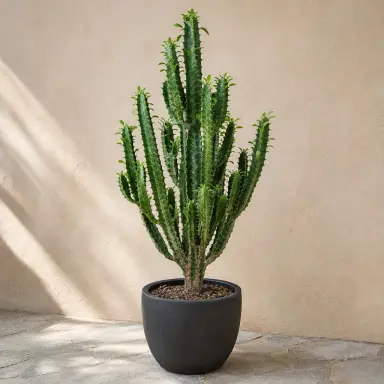 Whole plant
A African Milk Tree shown in full — overall shape and habit.
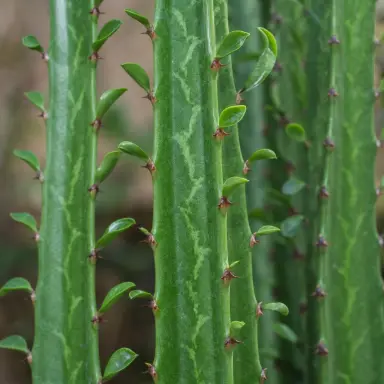 Leaf detail
Close-up of African Milk Tree leaves — texture, color, and edges.
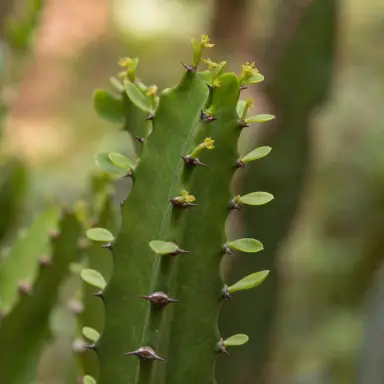 Flowers
African Milk Tree in bloom — flower form and color.
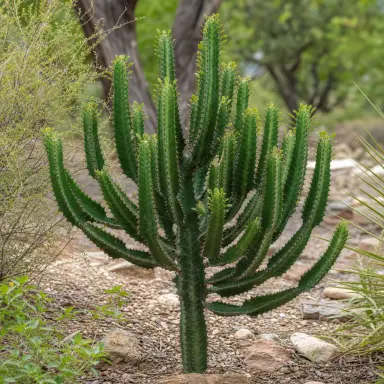 Growth form
African Milk Tree growing habit — stems, base, and offsets.
History
A brief account
African Milk Tree (Euphorbia trigona) is a bold, upright succulent known for its rapid growth and striking architectural form. Native to Central Africa, it develops tall, three-sided stems with pronounced ribs, pairs of short spines and small teardrop-shaped leaves. It has long been cultivated as a living fence and hedge in parts of tropical Africa, where its dense, thorny growth provides a practical barrier. Despite its cactus-like appearance, it is not a cactus but a member of the diverse Euphorbia genus. Like other euphorbias, it produces a milky white latex sap that can irritate the skin and eyes, so gloves should be worn when handling or pruning it.
How to care for
African Milk Tree thrives in bright light and can tolerate several hours of gentle direct sun once acclimatised. Plant it in a gritty, free-draining cactus or succulent mix and allow the soil to dry thoroughly between waterings. Reduce watering during winter, when growth naturally slows. Indoors, it can eventually grow several metres tall, so occasional pruning may be needed to maintain a manageable shape. Its upright growth and tolerance of dry conditions make it an impressive, low-maintenance statement plant.
How to propagate
The easiest way to propagate African Milk Tree is from stem cuttings. Cut a healthy section of stem with a clean blade, wearing gloves and eye protection to avoid contact with the milky sap. Allow the cutting to dry in a shaded, well-ventilated place until the cut surface has fully callused, then place it in a dry, gritty succulent mix. Water very lightly until roots develop. Cuttings establish most readily during the warmer growing season and can eventually develop into substantial, branching specimens of their own.
Cultivation
Quick tips for care & planting
- Light
- Bright indirect light to gentle direct sun.
- Water
- Every two weeks in summer; monthly in winter.
- Soil
- Standard cactus mix.
- Temperature
- 10–30°C. Frost-tender.
- Propagation
- Stem cuttings, callused for a week; wear gloves.