Plate No. 50
Desert Rose
Adenium obesum
"A caudex crowned in pink trumpets"
Native to
Sahel and eastern Africa, and the Arabian Peninsula

Identification
Is this your plant?
Compare these reference photographs to help identify a desert rose in your own collection.
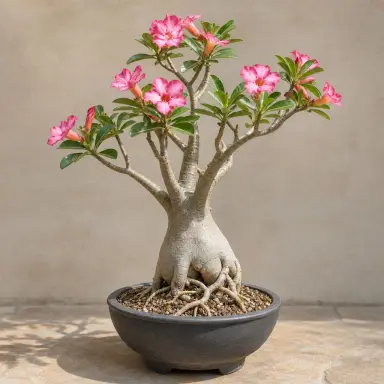 Whole plant
A Desert Rose shown in full — overall shape and habit.
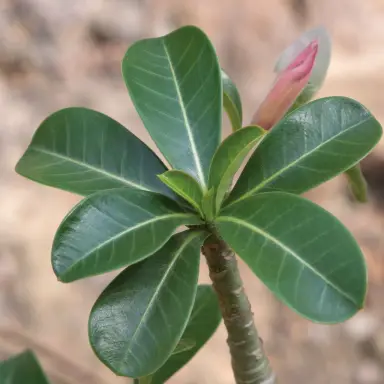 Leaf detail
Close-up of Desert Rose leaves — texture, color, and edges.
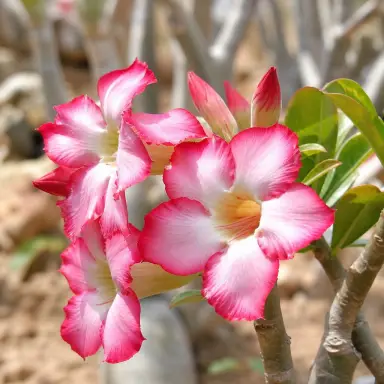 Flowers
Desert Rose in bloom — flower form and color.
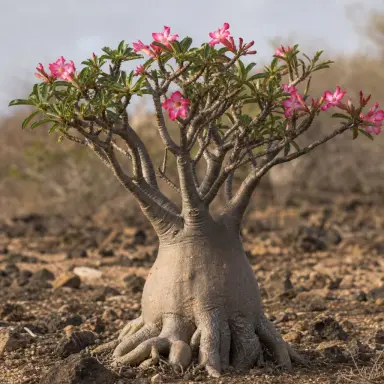 Growth form
Desert Rose growing habit — stems, base, and offsets.
History
A brief account
Desert Rose (Adenium obesum) is a striking caudiciform succulent native to arid regions of Africa and the Arabian Peninsula. Its most distinctive feature is its swollen base, or caudex, which stores water and gives mature plants the appearance of ancient miniature trees. Its spectacular trumpet-shaped flowers resemble those of its relative the oleander and range from white and pale pink to deep crimson. Desert Rose has become especially prized as a bonsai subject across Southeast Asia, where growers carefully train the branches and expose the sculptural roots to create dramatic specimens. Like oleander, the plant contains a toxic milky sap and should be handled with care.
How to care for
Desert Rose thrives in warmth, strong light and plenty of direct sun, all of which encourage compact growth and abundant flowering. Plant it in an exceptionally free-draining succulent mix and water thoroughly during active growth, allowing the soil to dry between waterings. In cooler months, the plant may lose some or all of its leaves and enter dormancy, when watering should be greatly reduced. It dislikes cold, wet conditions and should be protected from frost. Given enough sunshine and warmth, mature plants can produce repeated flushes of spectacular flowers throughout the growing season.
How to propagate
Desert Rose can be grown from seed or propagated from cuttings, but the two methods produce noticeably different results. Seed-grown plants are especially prized because they naturally develop the broad, swollen caudex that gives the species its characteristic sculptural form. Stem cuttings are quicker and preserve the flower colour of the parent plant, but they often develop a less pronounced caudex. Grafting is also widely used by specialist growers to combine unusual flower varieties with strong, vigorous rootstocks, creating the spectacular multi-coloured specimens often seen in collections.
Cultivation
Quick tips for care & planting
- Light
- Full direct sun.
- Water
- Generous in warm growth; keep bone dry through cool dormancy.
- Soil
- Extremely fast-draining gritty mix.
- Temperature
- 15–35°C. Frost-tender.
- Propagation
- From seed for a true fat caudex; cuttings root but stay slender.