Plate No. 14
Pencil Cactus
Euphorbia tirucalli
"Sculptural pencils of jade and coral"
Native to
Semi-arid regions of eastern and southern Africa

Identification
Is this your plant?
Compare these reference photographs to help identify a pencil cactus in your own collection.
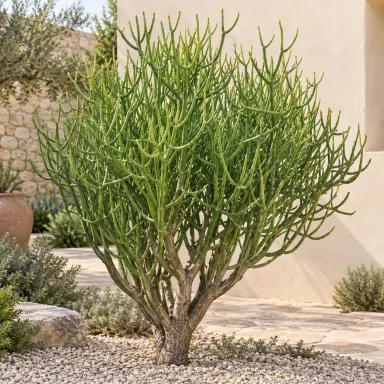 Whole plant
A Pencil Cactus shown in full — overall shape and habit.
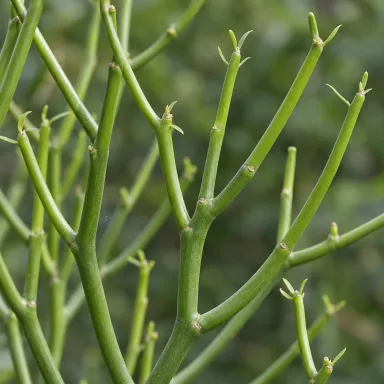 Leaf detail
Close-up of Pencil Cactus leaves — texture, color, and edges.
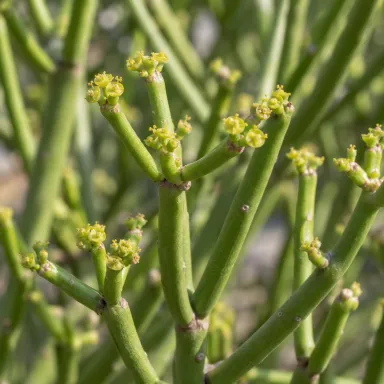 Flowers
Pencil Cactus in bloom — flower form and color.
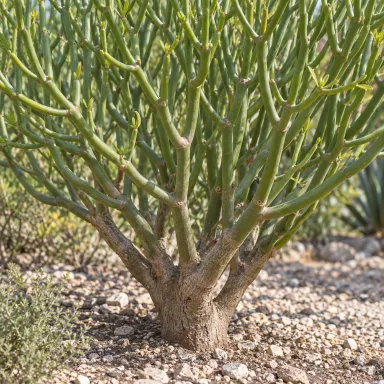 Growth form
Pencil Cactus growing habit — stems, base, and offsets.
History
A brief account
Pencil Cactus is a striking, architectural succulent whose thin, upright stems give it the look of a living sculpture. It is native to the semi-arid regions of eastern and southern Africa, where it grows in hot, dry landscapes and has long been valued for its toughness as much as its form. In some communities, it has also been used in traditional medicine, and in recent years it has attracted attention for its potential as a fast-growing, drought-tolerant crop.
Its unusual appearance and vivid seasonal colour have made it popular with collectors who want something bold and modern. In strong light, the stems can take on rich coral or reddish tones, especially in winter, adding a dramatic accent to bright rooms or sunny gardens. It is a plant that looks almost sculptural even when it is not in flower.
As with many euphorbias, it should be handled with care because the milky white sap is irritating and can be harmful if it gets into the eyes or skin. It thrives in full sun, a very sharp-draining mix, and infrequent watering, making it ideal for people who want a plant that looks dramatic without needing constant attention. Stem cuttings root easily when given a little time to dry and callus first.
How to care for
Place Pencil Cactus according to its light needs: Full sun. Indoors, the brightest possible window. For watering, sparingly — once every two to three weeks in growth. For the potting medium, use sharp-draining mineral mix. Good drainage is essential: let surplus water escape freely and never leave the roots standing in a wet saucer.
18–27°C. Protect from cold draughts. Check the compost before watering instead of following a rigid calendar, since light, temperature, pot size and season all affect how quickly it dries. During slower growth, reduce watering and wait longer between drinks.
How to propagate
Take stem cuttings, allow the white sap to dry and the cut end to callus, then root them in dry, gritty soil. Propagation is most reliable during the plant's active growing season, when warmth and good light help new roots establish. Start with clean tools and healthy material, and keep the new plant in conditions appropriate for the parent.
Where a cutting or division creates a wound, allow the surface to dry before planting unless the method calls for immediate rooting in water or moist mix. Once roots form and fresh growth appears, gradually move the young Pencil Cactus into its normal watering routine; excess moisture is especially risky while the root system is still small.
Cultivation
Quick tips for care & planting
- Light
- Full sun. Indoors, the brightest possible window.
- Water
- Sparingly — once every two to three weeks in growth.
- Soil
- Sharp-draining mineral mix.
- Temperature
- 18–27°C. Protect from cold draughts.
- Propagation
- Take stem cuttings, allow the white sap to dry and the cut end to callus, then root them in dry, gritty soil.