Plate No. 13
Crown of Thorns
Euphorbia milii
"A thorny coronet that blooms year round"
Native to
Dry forests of Madagascar

Identification
Is this your plant?
Compare these reference photographs to help identify a crown of thorns in your own collection.
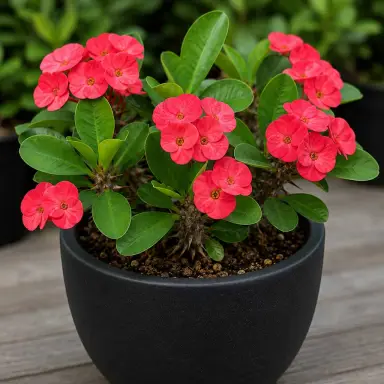 Whole plant
A Crown of Thorns shown in full — overall shape and habit.
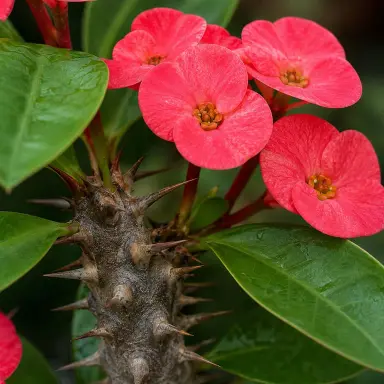 Leaf detail
Close-up of Crown of Thorns leaves — texture, color, and edges.
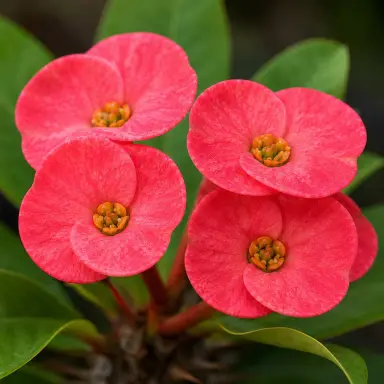 Flowers
Crown of Thorns in bloom — flower form and color.
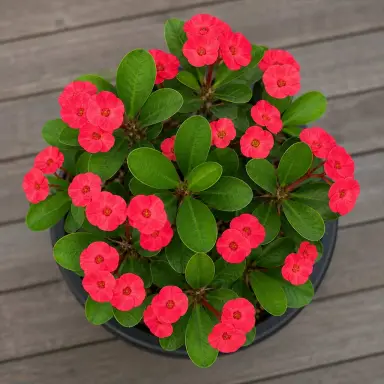 Growth form
Crown of Thorns growing habit — stems, base, and offsets.
History
A brief account
Native to the dry, rocky landscapes of Madagascar, Crown of Thorns (Euphorbia milii) was introduced to Europe in 1821 by Baron Milius, the French governor of Réunion, from whom the plant takes its species name. Its common name comes from a long-standing Christian tradition that its woody, thorn-covered stems were woven into the crown placed on Christ during the crucifixion. While there is no historical evidence to support this legend, it has become deeply associated with the plant and contributed to its enduring popularity.
In Thailand, where it is known as poi sian (“plant of the eight immortals”), Crown of Thorns is regarded as a symbol of prosperity, protection and good fortune. Traditional belief holds that a plant producing eight or more flowers at once brings luck and success to the household, making it a popular gift for new homes and businesses.
Despite its formidable spines, Crown of Thorns is an exceptionally tough and rewarding succulent. It flowers almost continuously in warm, bright conditions, producing colourful red, pink, yellow, white or cream bracts that surround the tiny true flowers at their centres. Modern hybrids are especially floriferous and can bloom throughout the year.
This drought-tolerant plant thrives in full sun and requires a fast-draining cactus or succulent mix. Allow the soil to dry completely between waterings, as excessive moisture can quickly lead to root rot. A terracotta pot helps keep the roots healthy by allowing excess water to evaporate. During winter, reduce watering while the plant’s growth slows.
When pruning or repotting, wear gloves. Like all euphorbias, Crown of Thorns produces a milky white latex sap that can irritate the skin and eyes and is toxic if ingested by people or pets. With plenty of sunlight and minimal care, however, it can live for decades, gradually developing thick, sculptural stems covered with distinctive spines and crowned with masses of colourful blooms.
How to care for
Place Crown of Thorns according to its light needs: Bright, direct sun for at least four hours daily. For watering, when the top inch of soil is dry; reduce in winter. For the potting medium, use well-draining cactus mix with added grit. Good drainage is essential: let surplus water escape freely and never leave the roots standing in a wet saucer.
16–27°C. Frost-tender. Check the compost before watering instead of following a rigid calendar, since light, temperature, pot size and season all affect how quickly it dries. During slower growth, reduce watering and wait longer between drinks.
How to propagate
Stem cuttings; allow the milky sap to dry before potting. Propagation is most reliable during the plant's active growing season, when warmth and good light help new roots establish. Start with clean tools and healthy material, and keep the new plant in conditions appropriate for the parent.
Where a cutting or division creates a wound, allow the surface to dry before planting unless the method calls for immediate rooting in water or moist mix. Once roots form and fresh growth appears, gradually move the young Crown of Thorns into its normal watering routine; excess moisture is especially risky while the root system is still small.
Cultivation
Quick tips for care & planting
- Light
- Bright, direct sun for at least four hours daily.
- Water
- When the top inch of soil is dry; reduce in winter.
- Soil
- Well-draining cactus mix with added grit.
- Temperature
- 16–27°C. Frost-tender.
- Propagation
- Stem cuttings; allow the milky sap to dry before potting.