Plate No. 06
Burro's Tail
Sedum morganianum
"A trailing cascade of plump tears"
Native to
Veracruz, Mexico, where it drapes from limestone cliffs

Identification
Is this your plant?
Compare these reference photographs to help identify a burro's tail in your own collection.
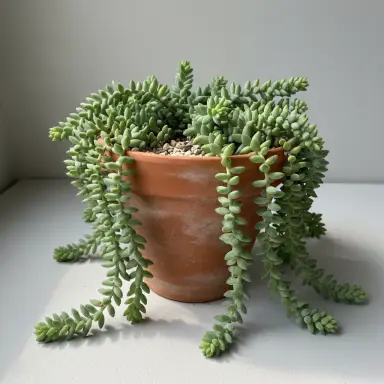 Whole plant
A Burro's Tail shown in full — overall shape and habit.
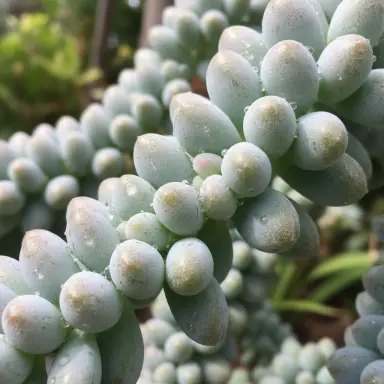 Leaf detail
Close-up of Burro's Tail leaves — texture, color, and edges.
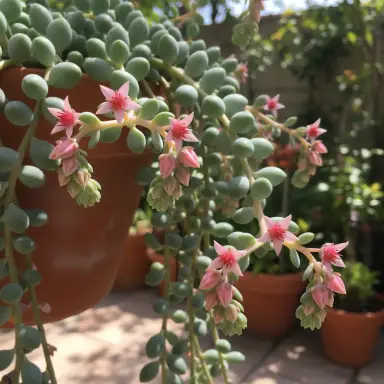 Flowers
Burro's Tail in bloom — flower form and color.
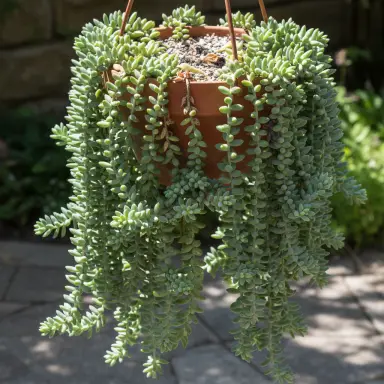 Growth form
Burro's Tail growing habit — stems, base, and offsets.
History
A brief account
Burro’s Tail (Sedum morganianum) is one of the world’s most iconic trailing succulents, instantly recognised by its long, pendulous stems densely packed with plump blue-green leaves. Although now grown in homes across the globe, the plant remained unknown to Western science until the 1930s, when American botanist Eric Walther traced cultivated specimens to a single nursery near Veracruz, Mexico. Surprisingly, despite its immense popularity, naturally occurring populations have always been extremely difficult to locate. The species is believed to grow on steep, rocky canyon walls and cliffs in eastern and southern Mexico, where its inaccessible habitat has kept it largely hidden from botanists.
Its thick, overlapping leaves act as water reservoirs, allowing the plant to survive long periods of drought, while the cascading stems can spill over rocky ledges in nature or hanging baskets in cultivation. The species name morganianum honours American horticulturist Meredith Morgan, who helped introduce the plant into cultivation. Today, Burro’s Tail remains one of the most sought-after trailing succulents, admired for its sculptural appearance and spectacular waterfall-like growth.
How to care for
Burro’s Tail thrives in bright light with several hours of gentle morning or late afternoon sun. Indoors, a bright windowsill is ideal, while outdoors it benefits from protection against intense midday heat. Plant it in a very free-draining cactus or succulent mix and always use a pot with excellent drainage. Allow the soil to dry completely between waterings, as the fleshy leaves store ample moisture and are highly susceptible to rot if kept too wet. Water sparingly during winter when growth slows.
One characteristic of Burro’s Tail is that its leaves detach very easily when touched. Although this can make repotting a little messy, it is perfectly normal and does not usually harm the plant. Mature specimens occasionally produce small clusters of pink to reddish flowers near the tips of their stems, although flowering is less common indoors. Given the right conditions, the trailing stems can exceed one metre in length, creating a spectacular cascading display for hanging baskets, shelves and elevated planters.
How to propagate
One of the joys of growing Burro’s Tail is that almost every detached leaf has the potential to become a new plant. Simply place fallen leaves on the surface of a dry, free-draining succulent mix and wait. Over the following weeks, tiny roots and a miniature rosette will emerge, gradually drawing energy from the original leaf until it naturally withers away.
Longer stems can also be used to create new plants. Trim a healthy section, allow the cut end to dry for several days, then plant it into a gritty potting mix. Because Burro’s Tail grows slowly, patience is rewarded, but once established, the cuttings develop into graceful trailing plants that can eventually produce the same impressive cascading stems as the parent. Rather than discarding any leaves that fall during handling, consider them the beginning of your next plant.
Cultivation
Quick tips for care & planting
- Light
- Bright light with some gentle morning sun.
- Water
- Sparingly — leaves drop at the lightest touch when over-handled.
- Soil
- Loose, gritty mix in a hanging container.
- Temperature
- 18–24°C year round.
- Propagation
- Dropped leaves callous and root readily on dry soil.