Plate No. 05
String of Pearls
Curio rowleyanus
"A cascade of green beads"
Native to
Drylands of southwest Africa, including Namibia

Identification
Is this your plant?
Compare these reference photographs to help identify a string of pearls in your own collection.
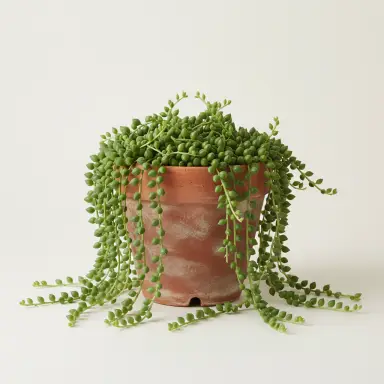 Whole plant
A String of Pearls shown in full — overall shape and habit.
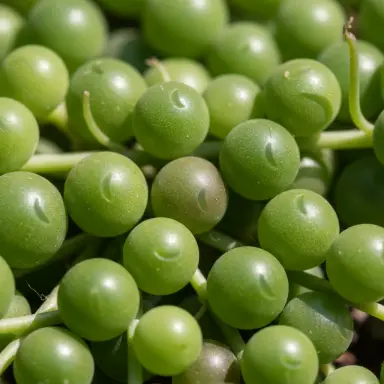 Leaf detail
Close-up of String of Pearls leaves — texture, color, and edges.
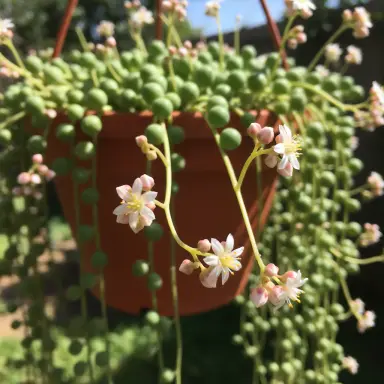 Flowers
String of Pearls in bloom — flower form and color.
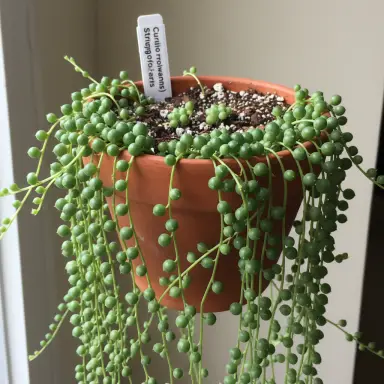 Growth form
String of Pearls growing habit — stems, base, and offsets.
History
A brief account
String of Pearls (Curio rowleyanus, formerly Senecio rowleyanus) is one of the most distinctive trailing succulents in cultivation, admired for its long cascading stems covered with perfectly rounded, bead-like leaves. Native to the arid regions of South Africa and Namibia, it grows naturally beneath shrubs and among rocks, where its trailing stems spread across the ground or hang over rocky ledges. Its remarkable spherical leaves are a clever adaptation that minimise surface area, reducing water loss while storing precious moisture for long periods of drought. Each bead also features a small translucent stripe, or “leaf window,” which allows sunlight to penetrate deep into the leaf for more efficient photosynthesis.
The species was formally described by British botanist Gordon Douglas Rowley, one of the world’s leading authorities on succulents, and its species name rowleyanus honours his contributions to succulent botany. More recently, advances in plant classification have moved the species from the genus Senecio into Curio. Its unusual appearance quickly made it a favourite among collectors, and today it remains one of the world’s most popular hanging succulents. Whether displayed in baskets, on shelves or in elevated planters, its flowing stems create a dramatic waterfall of green pearls unlike any other houseplant.
How to care for
String of Pearls thrives in bright, indirect light with several hours of gentle morning sun. Too little light results in sparse growth and long gaps between the beads, while harsh afternoon sun may scorch the foliage. Plant it in a very free-draining cactus or succulent mix and always use a pot with excellent drainage. Allow the soil to dry out completely before watering thoroughly, then let it dry again before the next watering. Like many trailing succulents, it is far more tolerant of drought than overwatering, which can quickly lead to root rot.
Although grown primarily for its unusual foliage, mature plants may produce small white flowers during late winter or spring. The blooms have a sweet cinnamon or clove-like fragrance and are followed by tiny seeds if pollinated. With bright light, careful watering and good airflow, String of Pearls can develop trailing stems well over a metre long, creating a spectacular cascading display.
How to propagate
String of Pearls is exceptionally easy to propagate. The simplest method is to lay healthy stem cuttings directly onto the surface of moist succulent mix, ensuring that several nodes remain in contact with the soil. New roots will form from each node, allowing the cutting to establish quickly. Stem cuttings can also be rooted in water before being transferred to soil, although direct soil propagation is usually more reliable.
Individual beads occasionally root if they are healthy and allowed to callus before being placed on well-drained soil, but propagation from stem cuttings is much faster and more successful. For a fuller hanging basket, growers often coil long stems back onto the surface of the pot, where they root at multiple points and produce dense, cascading growth. With minimal effort, a single plant can quickly become a lush curtain of trailing green pearls.
Cultivation
Quick tips for care & planting
- Light
- Bright, indirect light. Avoid scorching afternoon sun.
- Water
- Light watering every two weeks. Beads shrivel when thirsty, bursting back within a day.
- Soil
- Shallow pot with sandy, fast-draining mix.
- Temperature
- 20–24°C. Keep above 10°C in winter.
- Propagation
- Lay a length of stem on soil or place detached beads on dry, gritty mix; roots will usually form at the nodes once they have callused.