Plate No. 08
Living Stones
Lithops spp.
"Stones that bloom"
Native to
Arid pebble fields of Namibia and South Africa

Identification
Is this your plant?
Compare these reference photographs to help identify a living stones in your own collection.
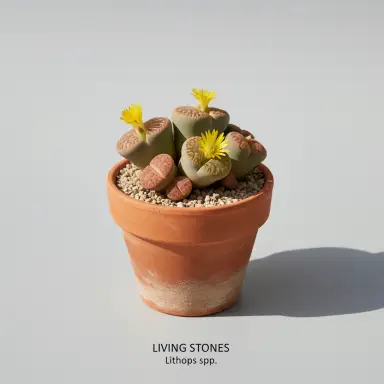 Whole plant
A Living Stones shown in full — overall shape and habit.
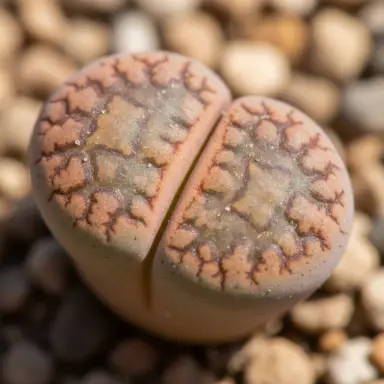 Leaf detail
Close-up of Living Stones leaves — texture, color, and edges.
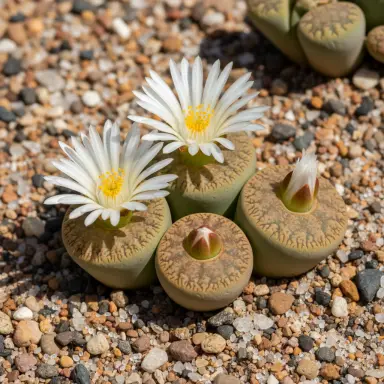 Flowers
Living Stones in bloom — flower form and color.
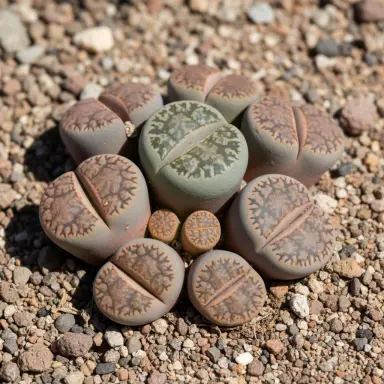 Growth form
Living Stones growing habit — stems, base, and offsets.
History
A brief account
Living Stones (Lithops spp.) are among the most extraordinary succulents in the world, resembling small pebbles rather than plants. Native to the arid regions of Namibia and South Africa, they grow among gravel plains and rocky outcrops where their remarkable camouflage helps protect them from grazing animals. Each plant consists of just two thick, fleshy leaves fused together into a pebble-like body, with only a small translucent window at the top exposed to the sun. This ingenious adaptation allows light to reach the interior of the plant while keeping most of its water-storing tissue safely below the scorching desert surface.
The first European to record Living Stones was the explorer William John Burchell in 1811, who famously mistook them for unusual pebbles until he looked more closely. The genus name Lithops comes from the Greek words lithos (stone) and opsis (appearance), meaning “stone-like.” Today, more than 30 species are recognised, each displaying its own intricate patterns, colours and markings that closely mimic the rocks of its native habitat. During autumn, mature plants surprise growers by producing daisy-like flowers in white, yellow or occasionally pink, creating a striking contrast against their stone-like bodies.
How to care for
Living Stones require a different approach from most succulents, but their care is straightforward once their natural growth cycle is understood. They thrive in very bright light or full sun and should be planted in an extremely free-draining, mineral-rich soil with excellent drainage. Water only when the plant has noticeably softened or shrunk and the soil is completely dry. Overwatering is the most common cause of failure and can quickly cause the plant to split or rot.
One of the most fascinating stages of the Lithops life cycle occurs each year when a completely new pair of leaves develops inside the existing plant. As the new leaves grow, the old pair gradually shrivels away, transferring its stored moisture to the replacement leaves. During this renewal period, usually through winter and into spring, watering should be withheld until the old leaves have dried up completely. With patience and restraint, Living Stones can thrive for decades and become increasingly beautiful with age.
How to propagate
Living Stones reward patient growers rather than impatient ones. Mature plants occasionally divide naturally, producing multiple heads that can eventually form attractive clumps. Once these clumps are well established, they can be carefully separated during repotting, ensuring each division retains a healthy root system before being replanted into dry, gritty soil.
Most Lithops, however, are propagated from seed. Although slow, seed raising allows growers to enjoy the remarkable diversity of colours and patterns found within the genus. Fresh seed is sown on the surface of a fine mineral mix and kept lightly moist until germination. Young seedlings develop gradually over several years, eventually taking on the distinctive stone-like appearance that makes these remarkable plants unlike any other succulent.
Cultivation
Quick tips for care & planting
- Light
- Four or more hours of bright, direct sun daily.
- Water
- Almost none. Water sparingly in late spring and early autumn only.
- Soil
- Extremely gritty mineral mix — mostly pumice, sand and grit.
- Temperature
- 15–30°C. Tolerates surprising heat; rest dry in winter.
- Propagation
- Raise from seed or divide established clumps with great care, as these plants are slow to recover from disturbance.