Plate No. 10
Panda Plant
Kalanchoe tomentosa
"Velvet leaves of the highlands"
Native to
Granite outcrops of central Madagascar

Identification
Is this your plant?
Compare these reference photographs to help identify a panda plant in your own collection.
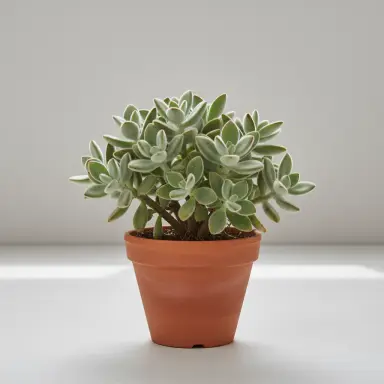 Whole plant
A Panda Plant shown in full — overall shape and habit.
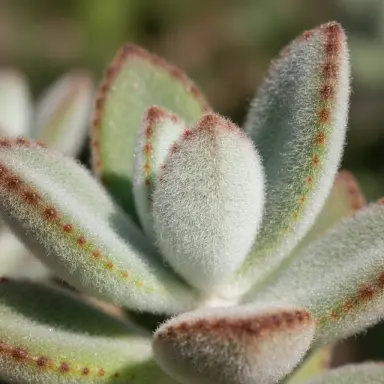 Leaf detail
Close-up of Panda Plant leaves — texture, color, and edges.
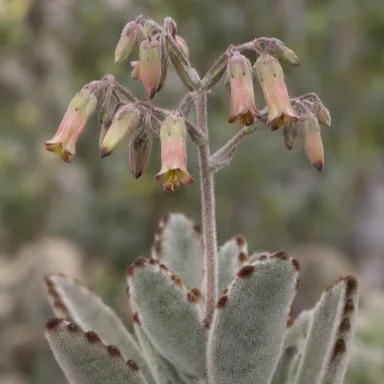 Flowers
Panda Plant in bloom — flower form and color.
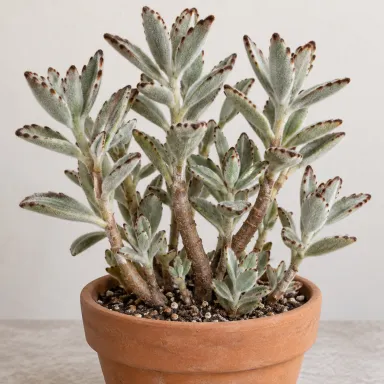 Growth form
Panda Plant growing habit — stems, base, and offsets.
History
A brief account
Panda Plant (Kalanchoe tomentosa) is one of the most distinctive succulents in cultivation, instantly recognised by its thick, velvety leaves edged with chocolate-brown markings. Native to the rocky highlands of central Madagascar, it grows in dry, sun-drenched environments where its dense covering of fine white hairs reflects intense sunlight, reduces water loss and helps protect the leaves from extreme temperatures. This soft, silvery coating gives the plant its familiar fuzzy appearance and has earned it common names including Panda Plant, Pussy Ears and Chocolate Soldier.
Like many Madagascan succulents, Panda Plant evolved to survive in shallow, nutrient-poor soils among granite outcrops, storing water in its fleshy leaves to withstand long dry periods. It entered cultivation during the 20th century and quickly became popular for its unusual texture, compact growth and low-maintenance nature. Although it rarely flowers indoors, mature outdoor plants can produce clusters of small, bell-shaped flowers on tall stems, but it is grown almost entirely for its attractive foliage.
How to care for
Panda Plant is an easy-care succulent that thrives in bright light with several hours of gentle direct sun each day. Strong light helps maintain the rich brown edging on the leaves and encourages compact, sturdy growth. Plant it in a free-draining cactus or succulent mix and allow the soil to dry completely before watering again. During winter, reduce watering considerably while growth slows.
Because the leaves are covered in fine hairs, it is best to avoid wetting the foliage whenever possible. Water trapped on the fuzzy surface can leave marks or encourage rot, particularly in cool conditions. With good light and careful watering, Panda Plant develops into a handsome branching shrub that can reach 60 cm (2 feet) or more in height, making it an attractive feature for bright windowsills and succulent collections.
How to propagate
Panda Plant can be propagated from both stem and leaf cuttings, although stem cuttings generally establish more quickly. Healthy leaves should be removed cleanly from the stem and left to dry for several days so the cut surface can callus before being placed on well-drained succulent soil. With time, tiny roots and new shoots will emerge from the base of the leaf.
Stem cuttings root readily using the same method and are ideal for rejuvenating older plants that have become leggy. Propagation is most successful during spring and summer when the plant is actively growing. Before long, the new plants develop their own soft, velvety leaves, making Panda Plant one of the most rewarding succulents to multiply and share.
Cultivation
Quick tips for care & planting
- Light
- Bright, indirect light with some gentle direct sun.
- Water
- Sparingly — let soil dry fully. Avoid wetting the fuzzy leaves.
- Soil
- Standard succulent mix with extra grit.
- Temperature
- 16–24°C year round. Frost-tender.
- Propagation
- Leaf cuttings root readily; let them dry briefly before planting and keep the leaves dry while they establish.